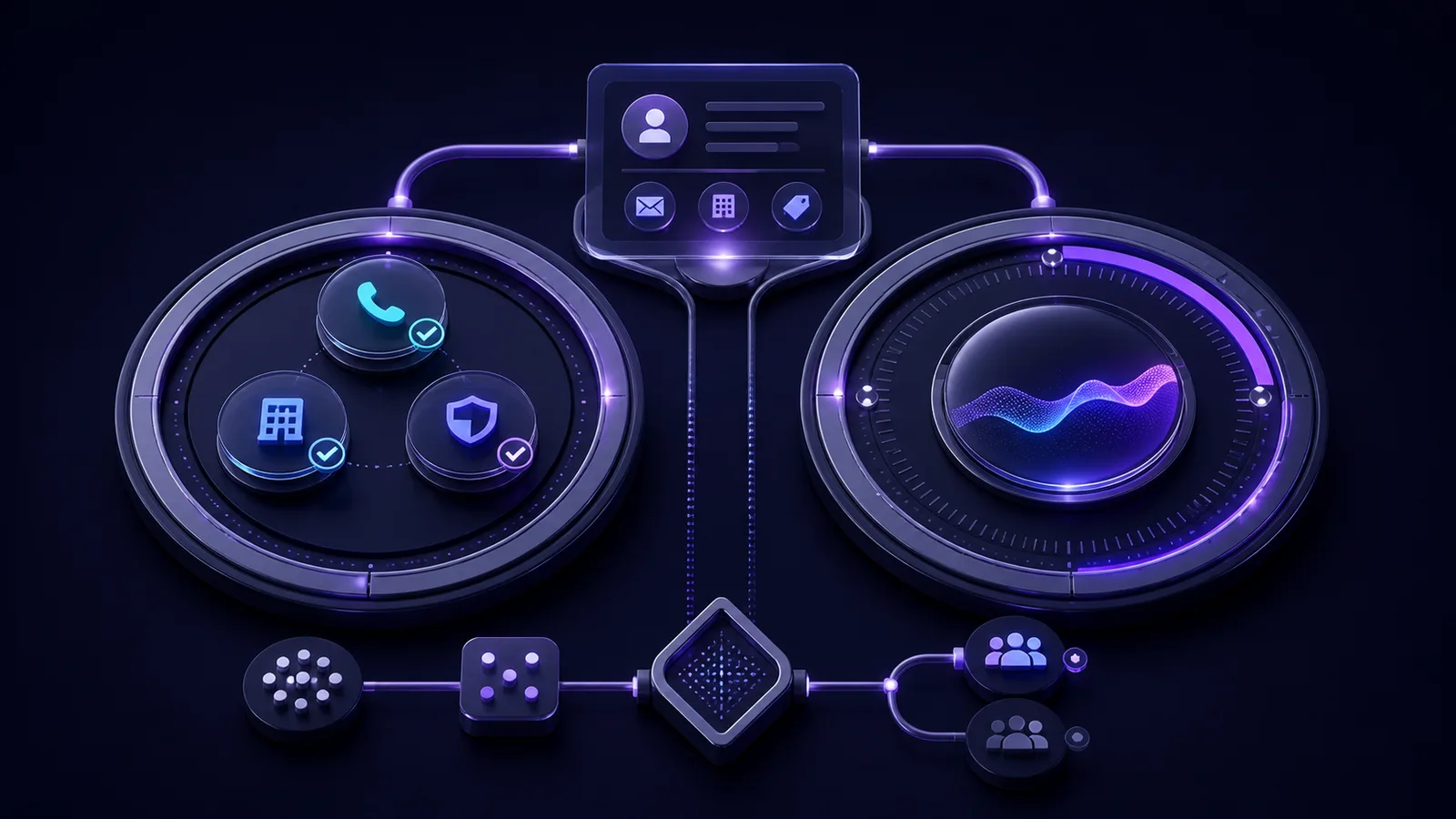
The terms are often bundled because one company can use scores inside its qualification model. They are still not synonyms. Salesforce's lead qualification guidance describes scoring as points for interactions and grading as fit information, then combines both in a company-specific qualification model. That model answers a business decision. A score remains one input or output inside it.
Lead scoring vs qualification vs Lead Validation
| Process | Primary question | Typical inputs | Output | Safe system action |
|---|---|---|---|---|
| Lead Validation | Is the contact evidence usable and safe enough for automatic routing? | Normalized phone and email, provider evidence, duplicate evidence, and risk reasons | Named checks with status, confidence, and reason codes | Feed an explicit qualified, review, blocked, or error decision |
| Lead qualification | Does this Lead meet the Business's criteria for the next action? | Contactability, fit, stated Interest, policy, and routing-safety evidence | A decision or lifecycle stage with documented criteria | Route, hold for review, nurture, disqualify, or take another named action |
| Lead scoring | How should eligible records be ranked or segmented? | Configured properties, fit data, interactions, and behavioral events | A numeric score, band, or model category | Prioritize outreach, segment a workflow, or trigger a defined threshold |
Vendor language varies. HubSpot's current lead scoring documentation supports engagement, fit, and combined scores, each calculated from configured event and property rules. Salesforce uses score and grade as parts of qualification. The stable distinction is therefore not which vendor owns a label; it is the question, evidence, output, and action your system records.
Why overlapping inputs do not make the processes equal
A demo request, product-page visit, company size, or job title may contribute to a score. The same facts may also be qualification criteria. Reuse is reasonable when the system preserves meaning: a page visit is engagement evidence, while a required service area or usable contact path can be an eligibility rule.
Predictive or AI-assisted scoring does not remove the need to define that meaning. MadKudu's AI scoring setup requires teams to map attributes, behaviors, a conversion metric, and the training audience; create fit and engagement models; review performance; and choose workflow thresholds. Those are vendor-specific implementation steps, not proof that one model predicts accurately for every Business.
A valid-looking phone number can improve a contactability decision without proving purchase intent. A high engagement score can improve prioritization without proving that contact data is safe to route. Keep each piece of evidence attached to the question it can actually answer.
Qualification is a decision; scoring is a ranking signal
Qualification should end in an explicit next action. In Lucidity, a Validation Run
produces a Validation Outcome of
qualified, review, blocked, or
error. Only an allowed outcome proceeds toward a Destination and a
separate Delivery attempt. The
qualified Lead definition
explains that contactability-first boundary in detail.
A score usually has no safe action until a team defines thresholds and workflow rules. A value of 72 means nothing without the model version, eligible population, score range, evidence window, and action attached to that band. Even then, the score should prioritize among records that are already eligible for that workflow rather than erase independent safety evidence.
What goes wrong when one number replaces the decision
| Shortcut | Failure mode | Safer control |
|---|---|---|
| High score equals safe to route | Behavioral activity can hide unusable contact data or independent risk | Run contact and routing-safety checks before score-based priority |
| Low score equals blocked | A reachable person with limited tracked behavior can be silently discarded | Use nurture or lower priority unless explicit qualification evidence blocks |
| Provider error equals unqualified | Infrastructure failure is mistaken for evidence about the person | Record error or unknown evidence and apply a documented fallback |
| One global threshold | Different Businesses, workflows, or populations receive the same action | Version criteria and thresholds for the population they govern |
| Score without reasons | Operators cannot explain, review, or calibrate the routing result | Preserve component evidence, model version, outcome, and reason codes |
A safe workflow order
- Accept and normalize the inbound Lead. Keep the raw Intake boundary separate from any conclusion about quality or intent.
- Validate contactability and independent risk. Record each Validation Check, including unknown evidence and provider errors.
- Apply explicit qualification criteria. Decide whether the Lead is qualified, needs review, is blocked, or needs an error fallback.
- Resolve the routing action. Select eligible Destinations only after the qualification gate permits automatic Delivery.
- Use a score for priority when it adds value. Rank or segment eligible Leads using a documented model, threshold, and evidence window.
- Measure each boundary separately. Do not present a high score, a routing choice, or transport acceptance as proof that Delivery or conversion succeeded.
The practical order may branch by workflow, but the safety invariant stays the same:
intent scoring cannot silently clear a
review or blocked
outcome. Use the
Lead qualification checklist
for the evidence gate and the
Lead qualification software guide
to compare rule-based, validation, and predictive approaches.
Measure the model and the routing gate separately
| Boundary | Useful measurement | Required context |
|---|---|---|
| Validation | Qualified, review, blocked, and error rates | Accepted-Lead denominator, reason codes, provider health, and time window |
| Scoring | Volume and later outcomes by score band | Model version, population, threshold, evidence window, and declared outcome |
| Routing | Eligible Leads proceeding to each Destination | Qualification rule, routing rule, and fallback path |
| Delivery | Successful Deliveries divided by Delivery attempts | Connector, Destination, terminal outcome, and stated period |
Revisit both rules and scores as the evidence changes. Salesforce recommends monitoring and refining company-specific qualification models; MadKudu's setup also includes model-performance review and threshold monitoring. Calibration should not collapse the stages into one KPI. A model can prioritize well while the Delivery path fails, and a healthy Delivery path can carry poorly qualified Leads.
Primary sources checked August 20, 2026
- Salesforce Trailhead: Create a Lead Qualification Model
- HubSpot Knowledge Base: Understand the lead scoring tool
- MadKudu documentation: Setting up your AI scoring
Frequently asked question
When should a team validate contactability, apply qualification rules, or rank likely purchase intent?
Validate contactability as soon as an inbound Lead is accepted, then apply the Business's explicit qualification and routing-safety rules. Use a lead score afterward when the team needs to prioritize eligible Leads by fit or engagement. A score should not erase high-confidence block evidence or silently release an ambiguous Lead from review.
Put the routing gate before the intent score
Bring one approved website form, your required contact method, and one Destination. See how Lucidity records Validation Checks, holds ambiguous Leads for review, and preserves each later Delivery outcome without turning one score into every decision.
Request a Lead validation walkthrough