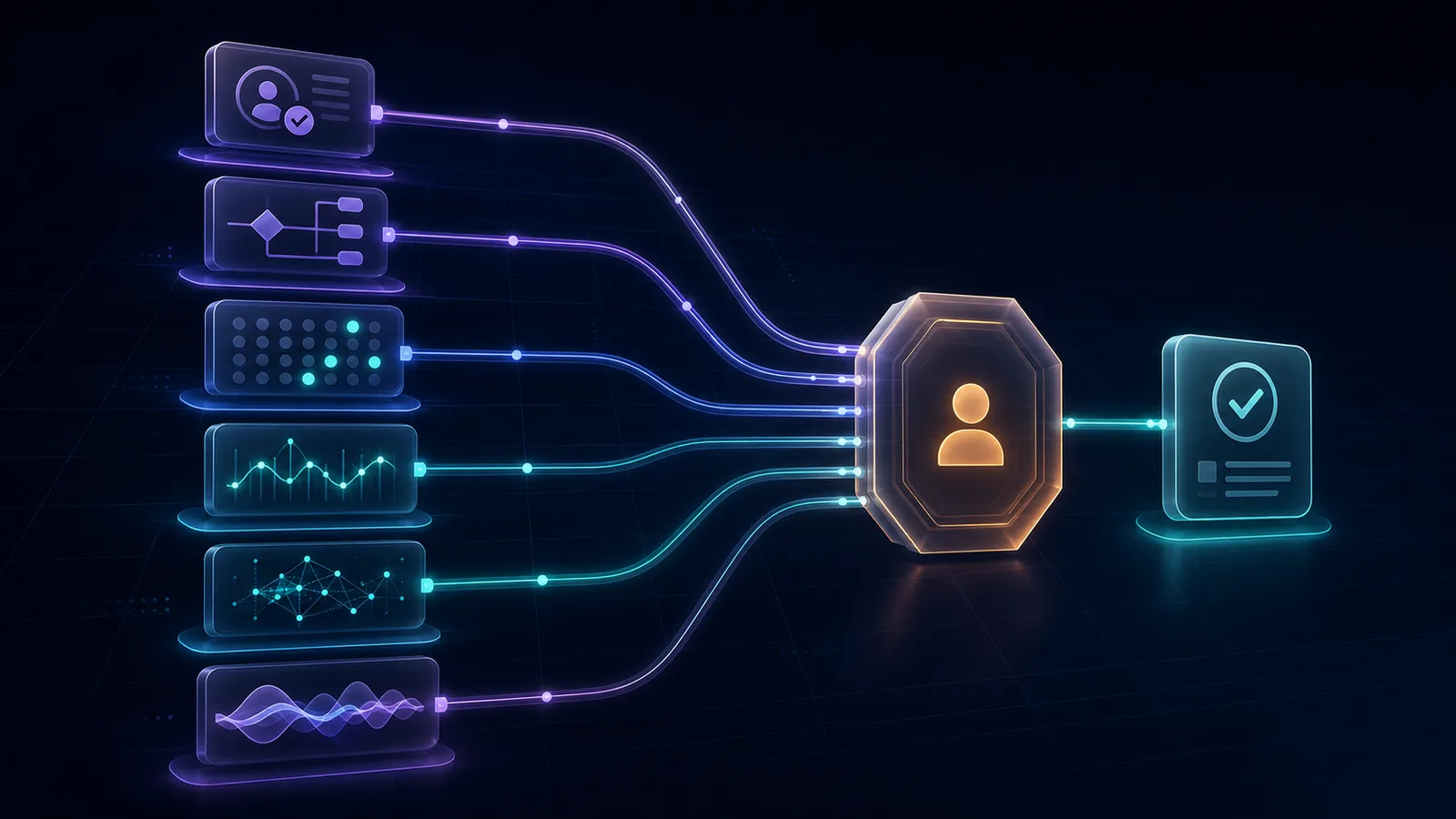
Which lead qualification software approach should you use?
Use contact validation when the first question is whether a Lead is reachable and safe to route. Use explicit rules when the business can state its criteria. Use fit and behavioral scoring to prioritize profile suitability and engagement. Use predictive scoring when enough clean historical data exists to train and monitor a model. Use conversation analysis when calls, chats, or form text contain the strongest intent evidence.
Most teams need a combination, not one universal score. A contactable person can have low purchase intent. A high-scoring account can still contain an invalid phone number. Software should preserve those facts separately, expose uncertainty, and define what happens before automatic routing.
| Approach | Primary question | Typical inputs | Useful output | What it does not prove |
|---|---|---|---|---|
| 1. Contact data validation | Can a person probably be reached safely through this contact path? | Phone format and status, email syntax and domain evidence, duplicates. | Per-field status plus a qualified, review, blocked, or error outcome. | Purchase intent, budget, authority, or product fit. |
| 2. Explicit business rules | Does this Lead satisfy criteria the business has defined? | Source, form, service, geography, answers, consent, and custom fields. | Explainable qualification, score adjustment, route, or review action. | That the criteria remain accurate as the market and process change. |
| 3. Profile fit grading | How closely does the person or account match the target profile? | Role, company, industry, size, region, and enrichment. | A grade or fit band tied to profile suitability. | Current engagement, contactability, or readiness to purchase. |
| 4. Behavioral scoring | How much relevant engagement has been observed? | Forms, page visits, email activity, product events, and recency. | A points score, engagement band, or threshold event. | That activity reflects real buying intent or a reachable person. |
| 5. Predictive scoring | Which Leads resemble historical outcomes in the training data? | Profile, behavior, outcomes, audiences, conversion labels, and overrides. | Predicted fit, engagement, likelihood, grade, or priority. | Causation, future certainty, or accuracy outside the training conditions. |
| 6. Conversation analysis | What intent, need, or outcome appears inside an interaction? | Call recordings, transcripts, chats, and submitted text. | Extracted intent, quality, outcome, topic, or follow-up signal. | Anything about Leads whose relevant conversation was not captured. |
What is the difference between validation, qualification, and scoring?
Validation checks evidence
Validation evaluates a field or signal, such as whether a phone number is structurally valid, whether an email has usable domain evidence, or whether a recent duplicate exists.
Qualification makes a decision
Qualification applies business policy to the evidence and decides whether the Lead should advance, wait for review, be blocked, or remain unresolved after an error.
Scoring orders records
A score assigns relative weight to profile or behavior. It can help prioritize, but its number has meaning only with documented inputs, thresholds, and a review cycle.
Delivery proves the handoff attempt
Qualification does not prove that a Destination accepted the Lead. That requires a separate Delivery attempt and outcome after the routing decision.
Salesforce's lead qualification model guide separates scoring from grading: interactions can contribute points, while prospect information can contribute a fit grade. Salesforce also says each business requires its own model and recommends monitoring and refining it. That is a useful warning against treating one threshold as universal truth.
Google Ads also treats a submitted lead form, a qualified lead, and a converted lead as separate conversion categories. The measurement labels do not choose a business policy, but they reinforce the process boundary: submission and qualification are different events.
1. Contact data validation
Contact validation asks a narrow operational question: is there enough evidence that a Lead can be contacted safely? Inputs can include phone parsing and normalization, email syntax and domain evidence, recent duplicate matches, obvious test patterns, and optional provider signals. This approach is strongest before a Lead enters a Destination where bad contact data creates cost, compliance risk, or wasted work.
Twilio's Lookup documentation describes phone number formatting and validation plus optional data packages for line type, status, identity, reassignment, and other signals. Each signal answers a different question. A number that fits a valid numbering range is not automatically owned by the person who submitted it, and a VoIP line is not automatically a bad Lead.
A responsible workflow keeps per-field statuses and avoids one weak signal becoming an automatic block. The Lucidity qualification model uses valid, invalid, risky, unknown, and missing for Validation Checks. The overall Validation Outcome is qualified, review, blocked, or error. A reachable human should not be discarded because one optional field is weak.
2. Explicit business rules
Rule-based qualification is appropriate when the business can state its decision criteria clearly. A rule can read first-party fields such as service requested, geography, form selection, Source, consent, duplicate status, or a custom answer and then qualify, hold, score, tag, or route the Lead.
WhatConverts documents Lead Intelligence as flexible IF/THEN rules and AI insights for qualification, scoring, valuation, data enrichment, ad-platform sync, and other actions. Its documentation shows that one system can combine several approach types. Buyers should still ask which condition produced the outcome and which later action was triggered.
Rules are explainable and can be changed without retraining a model. Their weakness is maintenance. A rule can encode an old assumption, conflict with another rule, or punish a field that was never required. Keep rule ownership, version, reason code, effective date, and test cases beside the decision.
3. Profile fit grading
Profile fit grading compares a person or account with a target profile. Typical inputs include role, company type, industry, size, region, technology, or other relevant attributes. The output is often a grade or band rather than a contactability decision.
Salesforce's qualification example uses grades for prospect information and scores for engagement. That division is useful because a strong profile match can still be inactive, while a highly engaged person can fall outside the intended market. The two dimensions can be combined for prioritization without pretending they are the same fact.
Fit grading depends on complete, current, and permitted data. Missing enrichment should remain missing rather than becoming a negative fact by default. Buyers should also ask whether a user can inspect the attributes behind a grade and correct an inaccurate profile.
4. Behavioral scoring
Behavioral scoring assigns weight to observed actions such as submitting a specific form, visiting a high-intent product page, opening an email, attending an event, or using a product feature. Recency and frequency may also change the score. This is useful for ordering follow-up when the business receives more Leads than a team can handle at once.
Salesforce's first-party guide gives separate point examples for interactions and recommends defining thresholds with sales and marketing. The important requirement is not the sample point value. It is the governance around why an event matters, how long it stays relevant, and which action the threshold authorizes.
Activity is evidence, not intent itself. A competitor, student, vendor, employee, or existing customer can generate many events. Protect the workflow with identity, consent, contact validation, profile context, and a review path instead of routing on an opaque total alone.
5. Predictive scoring
Predictive scoring uses historical profile, behavior, and outcome data to estimate a future result or priority. It can discover combinations that are difficult to encode manually, but the model inherits the definitions, omissions, and selection bias in its training data.
The current MadKudu and HG Insights scoring setup requires attribute mapping, behavior events, conversion definitions, training audiences, fit and engagement models, performance review, workflow thresholds, and ongoing monitoring. Its Lead Grade documentation combines customer fit and engagement or likelihood to buy in a configurable matrix.
That implementation sequence is a practical buying checklist. Ask which outcome is predicted, the date range and audience used for training, how missing values are handled, which explanations are visible, how often performance is reviewed, and what happens when data or customer behavior changes. Keep a human review path for consequential or ambiguous decisions.
6. Conversation analysis
Conversation analysis extracts signals from call recordings, transcripts, chats, or submitted text. Depending on the product and channel, outputs can include intent, topic, urgency, outcome, quality, compliance markers, or sales-handling observations. This can be valuable when the strongest evidence appears in the interaction itself.
Invoca's AI call tracking page says Signal AI measures phone-lead quality and uses conversation content to detect intent and outcomes. WhatConverts documents Ask AI rules that analyze call transcripts, chats, and forms, then make the extracted insight available to other rules and reporting.
The category boundary matters. Conversation analysis requires a captured interaction and the appropriate recording, privacy, consent, retention, and access controls. It does not replace phone-number validation, form capture, deterministic routing, or proof that a separate Destination accepted the Lead. Lucidity does not claim to provide call tracking or conversation intelligence.
How should you select a lead qualification workflow?
- Name the decision. Choose whether software must verify contactability, enforce policy, prioritize work, infer likelihood, interpret a conversation, or combine those jobs.
- Inventory first-party inputs. List the fields, events, interactions, outcomes, consent, and Data Freshness available before buying enrichment or AI.
- Separate evidence types. Keep contact validity, profile fit, engagement, predicted likelihood, and conversation findings in distinct fields.
- Require explanations. Each automated outcome should retain the checks, rule version, score components, model version, or extracted signal that produced it.
- Define uncertainty. Decide when missing, conflicting, risky, or failed evidence creates review instead of an automatic block.
- Define the routing gate. State which outcomes can create automatic Delivery and which require an operator.
- Measure downstream. Compare qualified, review, and blocked Leads with later Delivery and business outcomes using explicit denominators.
- Recalibrate. Review false positives, false negatives, overrides, source changes, and model drift on a fixed schedule.
What does a combined workflow look like?
Start with deterministic capture and contact evidence. Apply required business rules. Keep profile fit and observed behavior as separate dimensions. Add predictive or conversation signals only when they answer a defined question and their inputs can be governed. Then map the combined evidence to a named outcome and routing policy.
A useful sequence is: received, validating, qualified, review, or blocked, followed by a distinct Delivery outcome if routing occurs. The Lead qualification checklist turns that sequence into field-level checks. The lead quality guide explains how a review state protects reachable people from brittle automation.
In Lucidity, Lead Validation runs before automatic Delivery. Evidence can cover phone, email, address, name, duplicate, and Source checks. One strong contact path can qualify a Lead unless a high-confidence blocker applies. Ambiguous evidence can create review, and external validator failure does not become proof that the person is bad.
Keep qualification, Delivery, and GA4 facts separate
A qualified Lead is not proof that routing succeeded. Each attempt to forward one Lead to one Destination should create a separate Delivery outcome. The lead routing software guide separates pre-CRM Destination Delivery from CRM ownership, meeting, and phone-flow routing. The Lead Delivery guide explains what a Connector acknowledgment can and cannot prove.
Lucidity Leads, Validation Runs, and Deliveries are first-party operational facts. GA4 remains traffic context and may lag, be modeled, or change independently. Do not send personal contact data to GA4, and do not use a GA4 key event as the only record that a specific Lead passed validation or reached a Destination.
Gate one real Lead before automatic Delivery
Bring one safe website form and one Destination. See how Lucidity records Validation Checks, holds ambiguous evidence for review, and creates a separate Delivery outcome after qualification.
Request a validation-to-Delivery walkthrough