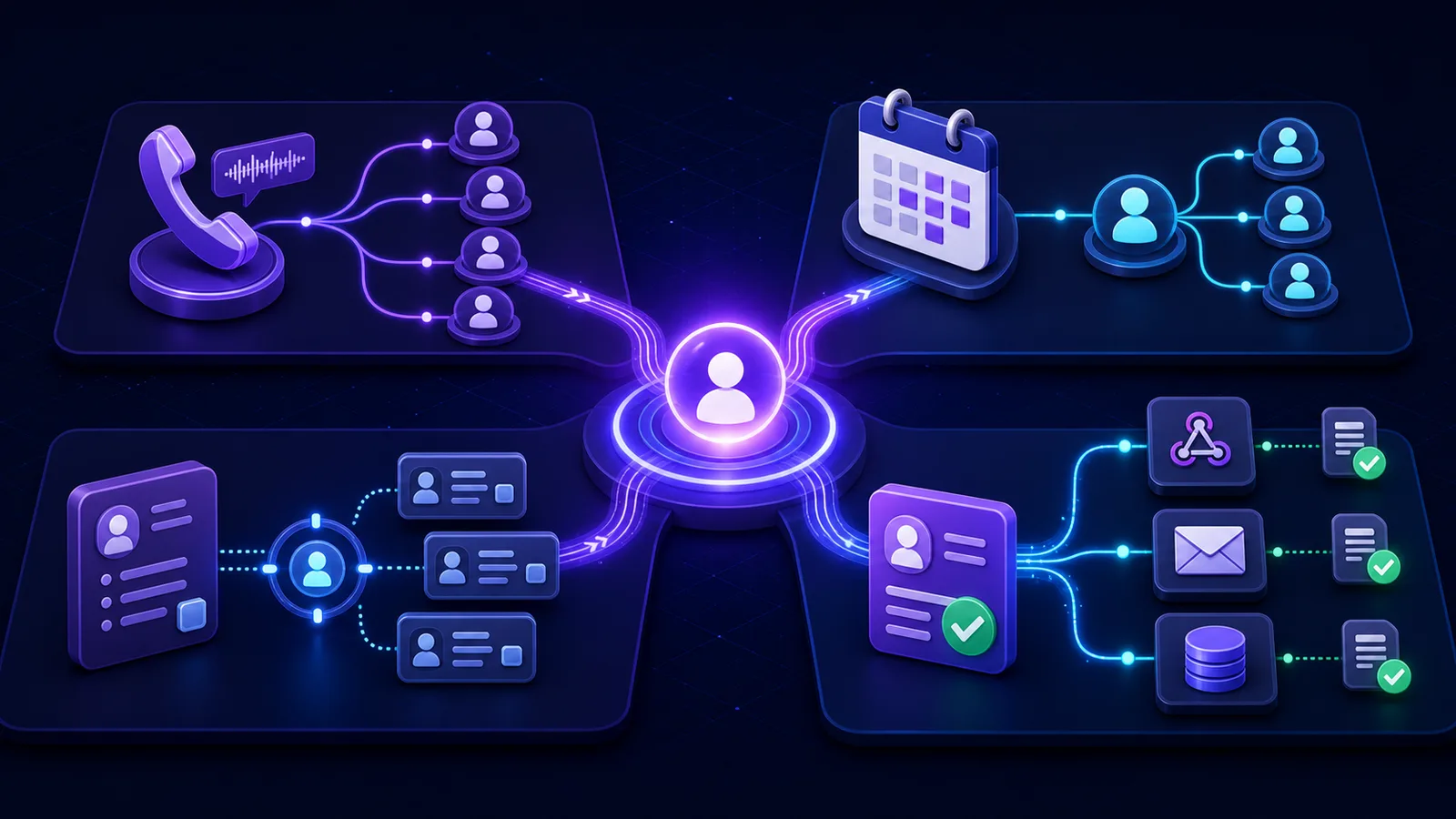
What is lead routing software?
Lead routing software applies rules to move an inbound inquiry to the next responsible person, queue, or system. The correct category depends on the object being routed. A phone call must reach a live call flow. A form visitor may need an available calendar. A CRM record needs an owner. A qualified Lead may need reliable Delivery to a CRM, webhook, dialer, or email Destination.
Do not buy from one generic feature checklist. Start with the event that begins the route, the decision the software owns, and the evidence that proves its work ended. Assignment is not the same as connection, and a successful transport response is not proof that a salesperson followed up.
| Routing type | Object and decision | Controls to require | Evidence of success |
|---|---|---|---|
| Live call routing | A phone session is sent to a menu, queue, person, or fallback. | Hours, geo rules, queues, simultaneous or round-robin ringing, failover. | Call-flow path, connection state, answer outcome, and timestamps. |
| Meeting and rep routing | A visitor is qualified and offered the right representative's calendar. | Qualification, ownership, availability, capacity, territory, fallback. | Rule match, selected rep, booked meeting, reassignment, and service level. |
| CRM record routing | A Lead, Contact, Account, or other CRM record receives an owner. | Matching, dedupe, territory, round robin, weighting, inactive-owner handling. | Record journey, rule version, owner change, audit log, and exceptions. |
| Pre-CRM Destination Delivery | A validated first-party Lead is delivered to one or more configured systems. | Validation gate, field mapping, idempotency, retries, safe error handling. | One Delivery attempt per Destination with a distinct outcome. |
How this comparison was built
This guide compares category boundaries, not a ranked vendor list. On July 21, 2026, we checked official product pages and documentation for Default, Chili Piper Distro, LeadAngel, and CallRail. Each appears here only as a first-party example of a routing job it documents. We did not run hands-on tests, score vendors, or infer capabilities that their current pages do not state.
The four categories can coexist in one revenue process. The point is to preserve the boundary and denominator for each. That makes a requirements matrix more useful than declaring one tool the overall winner.
Which type of lead routing tool do you need?
1. Live call routing
Choose this category when the object is an active phone call. CallRail's official Call Flow Builder page documents menus, round robin and simultaneous routing, schedules, geo-routing, voicemail, and other call-flow steps. The success boundary is the call path and connection outcome, not CRM ownership or later Lead Delivery.
2. Meeting and rep routing
Choose this category when a qualified form visitor should book the appropriate representative. Default documents routing by ownership, availability, work schedules, capacity, and other policies, followed by booking with the selected rep on its lead routing product page. Require evidence for both the routing decision and the meeting state.
3. CRM ownership routing
Choose this category when a CRM record needs a salesperson, team, or territory. Chili Piper describes Distro as routing standard and custom Salesforce objects with rules, ownership routing, matching, round robin, reports, and audit logs on its Distro product page. Distro's documented lead-distribution boundary is Salesforce, while form routing, chat, and scheduling sit in Chili Piper's wider platform.
4. Pre-CRM Destination Delivery
Choose this category when website inquiries must be captured, validated, and delivered to a CRM, webhook, dialer, or email recipient. In Lucidity, the target is a Destination and every attempt is a Delivery with its own outcome. That preserves the operational evidence before a downstream system assigns a rep. See a failed delivery and its recovery before deciding which evidence your workflow needs.
What requirements should every routing evaluation cover?
Define the input and system of record
Name the object entering the workflow and the system that owns it. A browser session, phone call, CRM Lead, Lucidity Lead, and Delivery are separate records. Write the required fields, source of those fields, and behavior when evidence is missing before translating requirements into rules.
For campaign and submission evidence, use the lead source attribution guide.
Put qualification before automatic Delivery
Require an explicit qualification gate, a review path, and an explanation when a lead is withheld. Do not buy on one opaque score or assume every submission should route.
The Lead qualification checklist provides twelve checks for contactability, duplicate evidence, business fit, and audit readiness before routing.
Make matching and geographic rules deterministic
Document rule order, tie-breaking, fallback behavior, and a reason for each outcome. Territory, postal code, product, Business, Location, account match, owner, capacity, and working hours may all affect a route, but an operator should still be able to explain why one path won.
LeadAngel's official material describes lead-to-account matching and routing across territories, round robin teams, and other assignment criteria. Its Lead Router guide also documents fallback handling when no routing logic applies. Use those controls as examples of explicit CRM assignment branches, not as evidence about pre-CRM Delivery.
Separate dedupe from idempotent handoff
Ask the vendor to demonstrate both a repeated inquiry and a retried handoff. They are different failure cases; the delivery guide's retry requirements explain what to verify at the receiving system.
Test inactive and unhealthy targets
Build cases for an unavailable rep, closed Location, expired authorization, disabled Destination, invalid endpoint, and downstream timeout. Each condition needs a defined fallback, review path, retry policy, or terminal failure. A catch-all should be an explicit operating decision, not an undocumented default.
Require an audit trail for the whole route
Record the input, rule version, matched branch, target, time, and outcome. Keep ownership assignment separate from transport acceptance and later human follow-up. The lead routing best-practices guide gives measurable failure signals for rule gaps, duplicate handoffs, retries, and missing Delivery evidence.
What do current vendor pages actually cover?
| Product | Documented category | Important boundary |
|---|---|---|
| CallRail Call Flow Builder | Live phone-call routing through configurable flow steps. | Call connection does not prove CRM ownership or downstream Lead processing. |
| Default | Routing, forms, enrichment, scheduling, workflows, and multi-CRM synchronization. | Its text-to-workflow, text-to-meeting, and native MCP features are labeled beta. |
| Chili Piper Distro | Salesforce object matching, ownership routing, round robin, audit, and service-level actions. | Distro lead distribution is Salesforce-only; wider platform features are separate. |
| LeadAngel | CRM lead-to-account matching, assignment, territories, and distribution reporting. | CRM assignment evidence does not by itself prove an external Destination accepted the Lead. |
| Lucidity | First-party intake, Lead Validation, pre-CRM routing, and Delivery outcomes. | It is not presented here as a live phone-flow or calendar-scheduling replacement. |
Capability names can look similar while their record boundaries differ. Verify the exact product and integration, especially when a vendor sells several modules under one platform name. Package contents can change, so verify the current commercial terms for the exact routing job instead of relying on a category article.
Lead routing software buying checklist
- Which object starts the route: call, visitor, form submission, CRM record, or Lead?
- Which decision does the product own, and which system remains the source of truth?
- Can rules use the required Business, Location, territory, owner, Source, and product data?
- How are missing data, multiple matches, inactive targets, and no-match cases handled?
- Does qualification gate the route, and is review separate from blocking?
- How does duplicate detection differ from idempotent retry protection?
- Which CRM, calendar, phone, webhook, email, and dialer integrations are native?
- Can operators preview a change, version rules, replay cases, and roll back safely?
- What evidence identifies the chosen branch, target, attempt, and final outcome?
- Can failures be retried or escalated without hiding terminal errors?
- What personal data, payloads, and credentials enter logs or vendor storage?
- What is generally available today, and what is beta or dependent on another module?
How should routing results be measured?
Use first-party records for the operational funnel: Leads received, Validation Outcomes, rules matched, Destinations selected, Deliveries attempted, and Delivery outcomes. Report stage-specific denominators so an ownership rate is not confused with a call answer rate or successful Destination response.
Use the source system's event for each metric. The routing audit worksheet turns those requirements into pass/fail checks.
Where does Lucidity fit?
Lucidity is designed for validated, pre-CRM Lead Delivery. A configured Intake
receives a first-party inquiry for a Business. Lead Validation determines whether it
is qualified, needs review, should be discarded, or encountered an error. The
dashboard label Discarded corresponds to blocked in the API. Default
forwarding sends qualified Leads to all enabled Destinations for the Business; a
request naming a Destination sends only there. Each Destination has its own Delivery
outcomes. Lucidity is not the rep-allocation or territory engine described in the
other categories.
That boundary helps agencies and direct workspaces answer the operational questions that generic assignment can hide: Was the Lead contactable? Which Business and optional Location owned it? Which Destination was selected? Was Delivery attempted? Did the handoff succeed, fail, or remain pending? CRM ownership and later sales outcomes can be connected without rewriting the original evidence.
Evaluate one real pre-CRM routing path
Bring one website form, one qualification rule, and one Destination. See how Lucidity keeps the Lead, routing decision, Delivery attempt, and outcome separately inspectable.
Request a Lead Delivery walkthrough